In the Age of Ad Automation, Signal Quality is Your Biggest Advantage
December 2, 2025

.jpg)
TL;DR Ad platforms have automated bidding, targeting, and placements, but signal quality remains in your control. Most teams optimize for proxy metrics like sign-ups or first purchases, which teach algorithms to find customers who convert but don't necessarily stick around. High-quality signals use predictive LTV to tell platforms what a customer is actually worth, changing which customers the algorithm finds.
Five years ago, paid media strategy was built on decisions… which audiences to target, how much to bid, where to place ads. Those decisions were the job.
Over the years, the algorithms got more sophisticated and automation has consumed many of those decisions. Meta's Advantage+ chooses your audiences. Google's Performance Max sets your bids and picks your placements.
Mark Zuckerberg himself has been blunt about where the ad landscape is heading.
.png)
So what's left for growth marketers to influence? How you communicate what a good customer looks like - what we call “signals.”
Learning how to create high-quality signals is one of the best skills a performance marketer can develop heading into 2026. Let's start with the basics.
First, what even is a signal in paid media?
A signal is data you send to ad platforms - specific events, conversions, or conversion values - that tells them what actions or outcomes matter to your business.
Think of it as a message you send to ad platforms saying "pay attention to this." Every time a prospective customer takes an action you care about - signing up for a free trial, making a purchase, engaging with your product - you can send a signal back to the platform that served the ad. The platform uses that signal to optimize who sees your ads next.
You tell the platform to optimize for free trial sign-ups. It shows your ad to people it thinks are likely to sign up. Some do. You send that conversion data back, and the algorithm learns from it. This loop runs thousands of times a day.
The algorithm gets very good at finding exactly what you asked for. And that's the problem.
Proxy metrics don’t tell the full story
Most teams optimize for proxy metrics like trial sign-ups, first purchases, app installs, lead form submissions. These are actions that might indicate a valuable customer, but don't guarantee it. A trial sign-up doesn't tell you if someone will convert to paid. A first purchase doesn't tell you if they'll come back.
The problem is structural. Ad platforms operate on short attribution windows (typically 7 days) because they need quick feedback to optimize in real time. But real customer value takes weeks or months to reveal itself. The platform is asking "was this a good customer?" before you have any way of knowing.
So the algorithm optimizes for what it can see. It finds people who sign up for trials - whether they stick around for years or disappear in two weeks. It never learns the difference.
This creates a cycle that's hard to spot. Your acquisition numbers look fine, but downstream, customer quality erodes.
What makes a high-quality signal?
A high-quality signal reflects what a customer is actually worth, not just the action they took. It tells the ad platforms on day one, "This user who just signed up is going to be worth $X over the next six months."
That precision helps platforms distinguish between users who will generate lasting value and those who will convert once and disappear. It gives the algorithm something meaningful to optimize against.
So now the question is, “How do you represent customer value before it shows up?”
How predictive LTV (pLTV) works
Predictive LTV is a machine learning approach that forecasts what a customer will be worth at the moment they convert.
You train models on your first-party data - behaviors, transaction history, engagement patterns, product usage, firmographic attributes.
The model identifies which early indicators correlate most strongly with long-term value. Maybe it's users who complete onboarding within 48 hours. Maybe it's users from certain industries or company sizes. Maybe it's a combination of dozens of variables buried in a sea of data that no human could spot.
When a new user converts, the model scores them in real time, generating a predicted LTV based on everything you know at that moment. Not perfectly, but accurately enough to send a much stronger signal than a simple conversion event.
This changes the feedback loop entirely. Instead of sending a binary signal, you're sending a weighted signal that communicates, "This person signed up, and they're likely worth $500."
The algorithm uses these values to inform bidding and targeting, prioritizing users who look like your highest-value customers.
As users engage with your product and your confidence in their value increases during that initial conversion window, you can send updated signals back to the platform. A day-one prediction based on sign-up data becomes a day-three signal informed by usage patterns, then a week-one signal validated by early retention.
Signal quality matters more than ever in 2026
Gartner’s 2025 CMO Spend Survey confirms what many teams are feeling: budgets are flatlining. Paid media still claims the largest share, but price inflation means growth teams are getting less for every dollar spent.
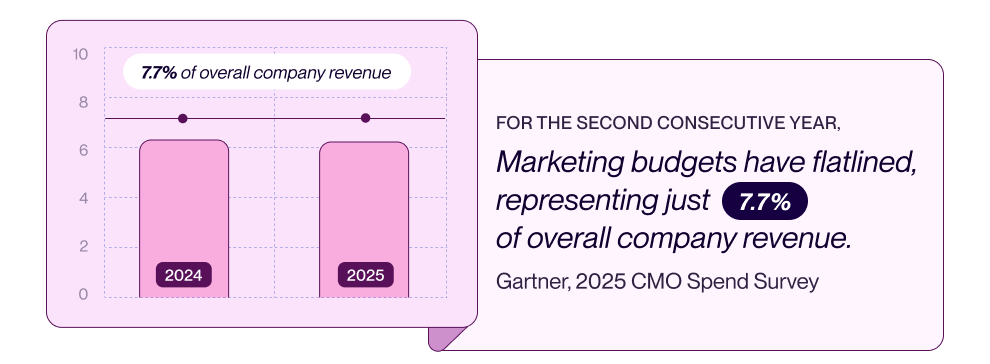
Flat budgets and rising costs mean there's no room for waste. Every dollar spent acquiring customers who churn is a dollar you can't get back.
Predictive signals help brands acquire fundamentally different customers using the same budget. Same spend, better outcomes. That's the closest thing to "doing more with less" that actually works.
Signal quality is a capability you build - one that compounds over time as your models get smarter and the algorithms learn what value actually looks like for your business.
If you're thinking about implementing predictive signals in 2026 (and we think you really should be!), we put together a full playbook on how to do it.
Download The Predictive Growth Playbook