
Instamart, India's Leading On-Demand Grocery Delivery Platform from Swiggy, Cut Cost Per Acquisition (CPA) by 51% with Signal Engineering





By the numbers
Overview
Company
Instamart is the quick-commerce grocery arm of Swiggy, one of India's leading on-demand delivery platforms, serving 120+ cities.
Industry
On-Demand Delivery
Headquarters
Bengaluru, India
Campaign Type
Google App Campaign
Most Valuable Users
Customers who make delivery part of their weekly routine
Snapshot

Growth at our scale is complex – two distinct businesses and hundreds of markets, all moving at once. With a business like Instamart won market by market, we needed a partner that could build to that complexity rather than around it. Voyantis did, winning us more new customers at a lower cost.
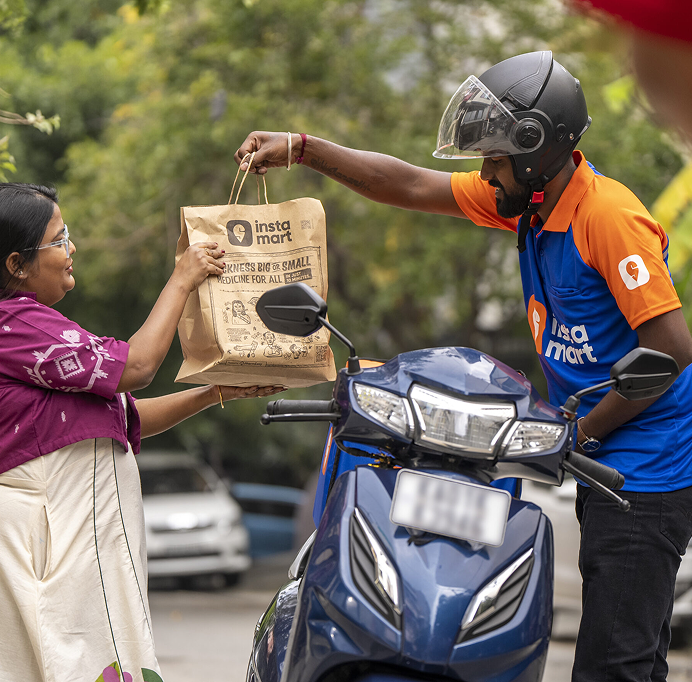
Instamart is the quick-commerce grocery arm of Swiggy, delivering groceries in minutes from a dense network of local stores, across more than 120+ cities. To deliver that at scale, the team aims to put the app in front of those who fold it into their lives for their weekly grocery run or as a go-to for meals. Optimizing tCPA against installs and first orders delivered volume at low cost, but whether that conversion turned into a regular or a one-time customer was invisible to Google.
Instamart set out to bring long-term value into the optimization window, partnering with Voyantis to build predictive signal infrastructure tailored to the scale and complexity of its business, and put to the test across both Instamart and its food delivery business. Today, Google bids according to the future value of new customers, not the cost of a conversion.
Impact at a glance
Acquired 34% more Instamart customers at 51% lower CPA
measured head-to-head against Instamart's own in-house model
Built a repeatable approach that could be applied to food delivery
with a model tuned to its own customers and markets, delivering 36% more new customers at 30% lower cost
Proven in a controlled geographic test
across dozens of live markets at once, measured on Instamart's own data
Laid the groundwork to scale predictive bidding across Instamart and beyond
with infrastructure that keeps pace with data, pricing, and product shifts
The challenge
Implementing value-based bidding at Instamart's scale is a major undertaking. Acquisition runs across hundreds of cities and two businesses with very different economics, established food delivery and fast-growing quick-commerce grocery. Instamart's grocery model is the more hyperlocal of the two, won city by city, market by market. At that scale, the wrong signal not only wastes budget but actively trains Google to bid for the wrong customers.
Instamart's data science team had built a strong predictive model of their own and set out to test value-based bidding with it. The harder problem was turning those predictions into signals that perform in the live auction, reliably and across every market. Even with a model in hand, getting there through trial and error would mean funding a long learning curve out of Instamart's own ad budget, at a scale where every misstep is expensive.
The solve
Our data science team had built a strong model – one that could tell a repeat customer from a one-time order – but activating it in a live auction through signal engineering is a discipline of its own. Voyantis brought the expertise to get it right and the technology to keep it performing as our business, the auction, and the market evolve.
Predict who will become a regular at the first order
Each part of Swiggy's business runs in its own growth context, with different customers, competitors, and goals. A single model couldn't serve both, so Voyantis built one for each, shaped around the question that mattered for its side of the business.
- Instamart's model answers a question of magnitude. How much will a customer be worth? It predicts their LTV after thirty days.
- Food delivery's model answers a behavioral question. Will a new customer become a regular? It forecasts propensity to place three orders within thirty days, the threshold that marks a forming Instamart delivery habit.
Both models read that early behavior, but each learned to weigh it based on thousands of different contextual and behavioral insights to capture each business nuance, including:
- Whether they join Swiggy One, and how fast
- How much they lean on discounts for food delivery
- What they build into a basket on Instamart delivery
The strongest early patterns weren't always the obvious ones. For example, commitment showed up before volume did. In the first hours after acquisition, how quickly a customer joined Swiggy One told the Food model more than how much they had spent. The full picture only emerges when these insights are weighed together, for every individual customer.
The result was a dependable read on who would become a regular, and by how much, so the auction could bid accordingly rather than treat every new customer as the same average bet.
Engineer the prediction into an auction-ready signal
Google's auction bids in currency and takes events given at face value. A prediction, which is always evolving, is treated as ground truth, steering the algorithms based on an incomplete view of customer value.
To bridge the gap, Voyantis engineered the model's scores into a signal fit to Swiggy's growth context and the learning logic of Google's algorithm:
- Timing: A prediction is generated at the moment of a customer's first order and delivered as a signal within hours – as soon as enough behavior has accumulated – to anchor Google's learning.
- Cadence: As the customer takes more action over the following days, the prediction sharpens and enhanced signals follow, when the change is meaningful enough.
- Value: For Instamart, every prediction is capped so the signals delivered to the auction keep a full spread of values to learn from, instead of piling budget onto a few inflated scores. For food delivery, the signal blends revenue earned from the first order with a forward estimate of the next 30 days.
That engineering, not the prediction, is what sets Voyantis apart from a capable in-house model. Both models could tell who was likely to keep ordering, but only one could turn that knowledge into a signal that moves the auction toward performance.
Activate in a live auction, market-by-market
To prove that engineered signals would drive better performance than a raw prediction, Voyantis ran a head-to-head for each arm of the business – one powered by its own predictive signals and the other by Swiggy's own model.
Instamart's business is significantly different city by city, so its test was built as a geographic split, with a matched set of markets running Voyantis signals against a matched set running the internal model at the same time. This isolated the signal's effect, without one market contaminating another. Food delivery ran the same design as a separate test.
Success was measured against Swiggy's own numbers, not Google's reported conversions. That distinction matters because Google's reporting runs on its own attribution and doesn't carry Swiggy's real KPIs, the revenue and retention that show whether an acquired customer was worth it.
Learn and evolve to keep the signal pointed at the right customers
Left alone, a signal drifts. The customers it wins today become the data the model learns from tomorrow. Meanwhile, Instamart's business – its pricing, products, and markets – keeps moving underneath it. To keep the model accurate and the signals chasing the right customers, Voyantis has 24/7 monitoring across three fronts:
- Pipeline Integrity: Autonomous monitoring flags when data pipelines break before the issue impacts performance.
- Model Health: Predictions are checked against real outcomes as cohorts mature and the model is retrained as needed.
- Learning Preservation: Changes are made gradually so Google's accumulated learning is always preserved and never reset.
Voyantis’ impact
34%
increase in new Instamart customers
51%
lower Instamart CPA
89%
increase in Instamart M1 ROAS
More customers at a lower cost
Against Swiggy's own model, Voyantis's signal engineering brought in more new customers for less for both businesses:
- Instamart Campaign: 34% more new customers, 51% lower cost per new customer (CPA), 89% higher M1 ROAS
- Food Delivery Campaign: 36% more new customers, 30% lower cost per new customer (CPA), 48% higher 30-day ROAS
With a sharper read on what each new customer was worth, Google could make the same spend go further, freeing up spend to reinvest. What Voyantis built is wired into how Instamart acquires new customers, one that can extend to new channels and stages of the customer lifecycle as the partnership grows.
We expected signal engineering to change who we acquired. Instead, it changed what they cost us, bringing customers in far more efficiently than before, with the long-term returns still ahead of us. It's now foundational to how we grow Instamart, and we're excited to see how the value compounds as the partnership expands.