The Two Outcomes of Signal Engineering: What to Expect and How to Measure It
April 16, 2026


TL;DR Signal engineering produces one of two outcomes. Either the network changes who it acquires, or it acquires the same users more efficiently and your CPA drops instead. Many campaigns see a mix of both, tipped one way or the other by your market position, LTV variance, and the channel. Both are wins that surface on different timelines, and knowing which one you're seeing is what keeps a working campaign from getting cut too early.
When you adopt predictive value-based bidding, you change the instruction you give the auction. Instead of optimizing for a binary conversion event, you’re now telling it to find users who will be worth more over time. Signal engineering is how you build that instruction, translating what you know about your best users into something the auction can learn from.
When that instruction is built around long-term value, the natural expectation is a shift in who shows up – people who purchase repeatedly, subscribe and renew, or come back to use your product week after week. Often, that's exactly what happens. Sometimes, though, signal engineering works perfectly and you never see it in your user mix at all. Instead of changing who it acquires, the auction prices the same users more accurately, and your CPA drops instead.
By design, the auction takes the path of least resistance, chasing whatever improvement is easier to unlock. All outcomes increase ROAS, but they show up differently in your campigns. After seeing these outcomes surface across hundreds of campaigns, we built a framework for what to expect, what influences the result, and how to measure it.
The Two Outcomes: Better Users or Better Prices
Outcome A: User Mix Shift
This is the outcome most teams picture when they adopt predictive value-based bidding. The network changes who it acquires, tilting toward a higher-value cohort. You are buying a fundamentally different population. What moves, and how:
- CPA holds flat or rises measured on the raw conversion event, because better users generally cost more and you are buying a larger share of them.
- ARPU and ARPPU climb over time, as the behavior that defines a high-value user manifests as they mature.
- The full picture of performance often takes 90 to 180 days, because that behavior hasn't happened yet on the day you acquire them.
User Selection in Action
Take Lennar, one of the largest homebuilders in the US, running on Google Search. On their standard tCPA campaigns, the instruction they gave Google was "find me people who fill out a form." So Google did exactly that, as cheaply as possible, treating a serious buyer and an idle browser as the same lead. The action that often separated the two – booking a tour with a New Home Consultant – surfaced weeks later, outside Google's learning window.
Shifting to tROAS campaigns powered by predictive signals rewrote the instruction to "find me people likely to book an appointment." Same audience, same channel, but a different definition of what counts as a win, and the network changed who it brought in to match. The impact:
- Lead-to-appointment conversion rose 40%, proof that better-fit buyers were coming through.
- While cost per lead rose, as expected, cost per appointment fell 15%, because the auction was bringing in higher value users.
Outcome B: CPA Price Calibration
This is the outcome fewer teams expect. The network keeps acquiring the same pool of users, but prices each more accurately. You get the same caliber of users for less money. The underlying mechanism is less dollars spent on auctions that would never convert to the top-of-the-funnel event. What moves, and how:
- CPA drops, often visible immediately, or within a few days.
- ARPU often stays flat, because these are the same users, bought more efficiently.
- The gain is immediate, because only the price changed.
CPA Calibration in Action
inDrive, the world's second-most downloaded ride-hailing app, shifted to predicted value bidding and landed on CPA calibration instead. The team's tCPA campaigns optimized toward first rides, which handed Google a single cost target for every rider. The riders inDrive cared about most were priced the same as one-timers at the moment of acquisition.
Moving to predicted value let Google price each rider against what that rider was actually worth. The improvement showed up in bid pricing rather than mix. In one market, they saw:
- Cost to acquire first-time riders drop 72%
- Cost to acquire frequent riders decrease 65%
- ROAS increase 120%, measured on net revenue
Why You Might See a Combined Shift
tCPA and pLTV predict different things. tCPA's whole job is guessing, for every impression, the chance that a click becomes a top-of-the-funnel conversion. So how do LTV predictions help with that guess?
The two are not independent. The same underlying appetite that makes someone transact often also makes them more likely to convert in the first place. Value after the conversion and intent before it are correlated. That correlation is what Google leverages. Under tCPA, Google's only teacher is a yes/no outcome on a small fraction of impressions – noisy guesses that are expensive in both directions. You overpay where it guessed too high, and lose users where it guessed too low.
When every conversion arrives tagged with a predicted value, each tag is also a graded hint about the intent of similar users. It’s the difference between grading students pass/fail and seeing their actual scores: you need far fewer exams to know who is doing good. Google's estimates sharpen faster, pricing mistakes shrink, and wasted budget gets redirected toward better users, at lower cost, or both.
What Influences the Outcome
While the auction makes the final call, several factors can tip it one way or the other.
The Spread in Your User Population
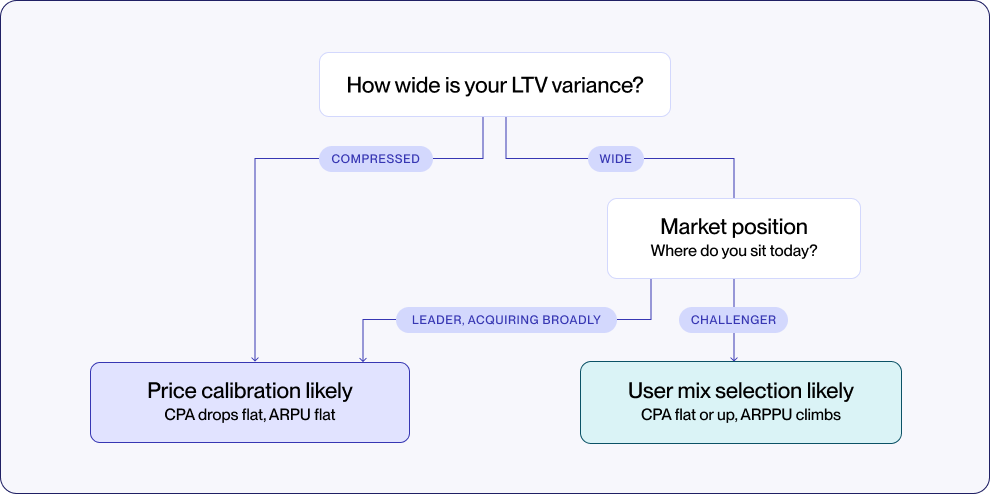
The primary driver is how much variance exists between your best and worst users. Market position is a useful proxy.
A market leader acquiring broadly tends to have a compressed spread, so the high-value users are already coming through and there's little mix left to find. A challenger with a wide spread between its best and worst users gives the auction differentiation to work with, and it learns to find more of the top end.
How Much the Auction Already Knows About the User
In Search campaigns, the auction tends to tip toward a user mix shift, because the query itself is insight into intent. Your predicted values add the dimension of which converters become a repeat customer. In App Campaigns, the auction leans toward CPA price calibration. Without a query, Google's understanding of each user is weaker, and the predictive signal's main job becomes sharpening noisy conversion estimates across a broad pool.
Take two users, one high-value and one unlikely to convert:
- On Search, the high-value user searched "transfer large balance," the tire-kicker searched "what is blockchain." Google already has strong insight into who's more likely to convert. What it can’t see is which one of those converters stays – your predictive signal adds that dimension, so Google bids up on the users worth more downstream, not just the ones most likely to convert. Winning those high-value queries means outbidding competitors who want the same users, so CPA rises because those auctions are worth the premium.
- On App Campaigns, the same two look identical before the bid: 25-34, iOS, US, 9pm. Your predicted value draws on what Google lacks, like purchase history, engagement patterns, activity inside your app. The network gets hints about user intent, and prices each auction more accurately, paying less for users it was overestimating and winning users it was underestimating.
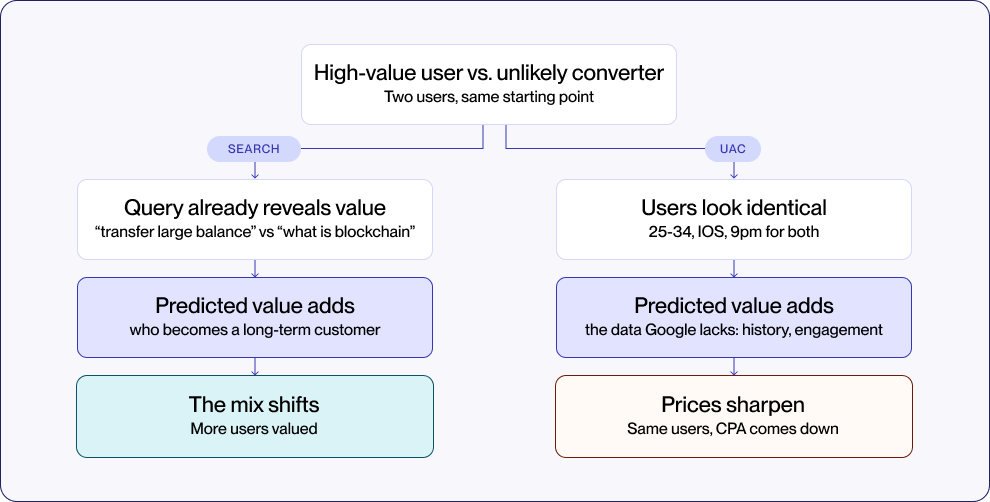
The real driver is the information, and the channel is a proxy for it. Feed an App Campaign enough first-party information and the network can shift the mix there too. Run Search on queries that are all high-intent and the gain comes as efficiency, because the queries have already done the selecting.
How to Measure for Both
Both outcomes take time to prove, and many campaigns land on some of each. The auction takes the cheapest improvement first, so the efficiency half of a blend shows up right away while the mix-shift is not demonstrated in ARPU and ROAS at Day 30. A campaign doing both can look like pure CPA calibration for its first month, and a team that declares the result early walks away from half the win.
Think about it like this - if you increased the number of monthly grocery purchasers from 10% of the population to 30% - you will not see this at all, in the first 30 days, suddenly you get a +20% bump at day 31, but an even higher bump by day 61, etc.
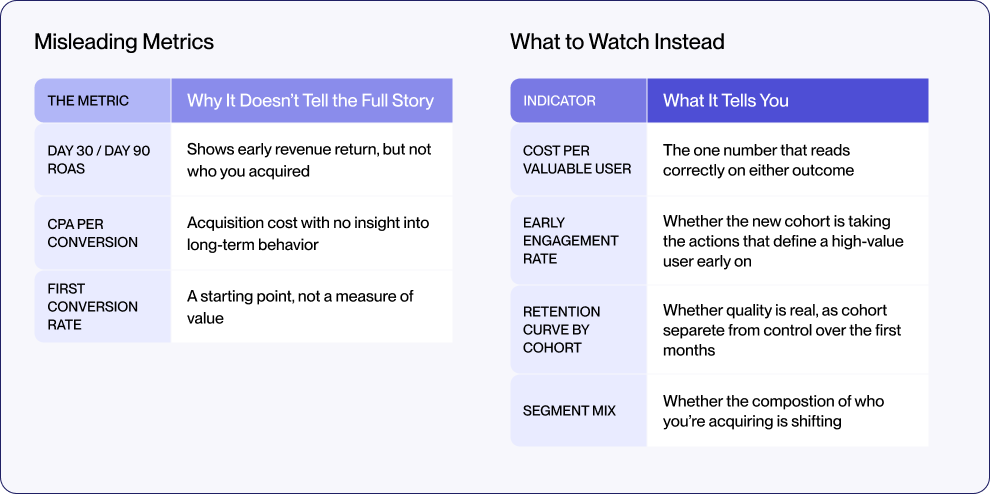
Cost per valuable user is the metric that cuts through both outcomes. Name the user that matters to your business – the one your team already trusts to spot a good customer weeks before the revenue proves it. For food delivery, that might be a second order within 30 days. For a fintech product, a third transaction by Day 45. Then track what it costs to acquire one.
How do you identify a valuable user on day 30? Your data team can easily answer that question. It is a much easier question to answer than how do you identify them on day 1.
This number works regardless of which outcome the auction delivers. If the mix shifts, you're winning more of those users even as blended CPA rises. If pricing sharpened, you're winning the same users for less. On a working campaign, the number moves in your favor either way.
Your Measurement Timeline
CPA calibration reads fast, a CPA drop inside 30 days tells you most of what you need, while a mix shift is the outcome that demands patience. How much depends on your business model.
For transaction businesses, mix shift is typically visible by Day 14, with a full readout by Day 90. For subscription businesses, the renewal window pushes that out:
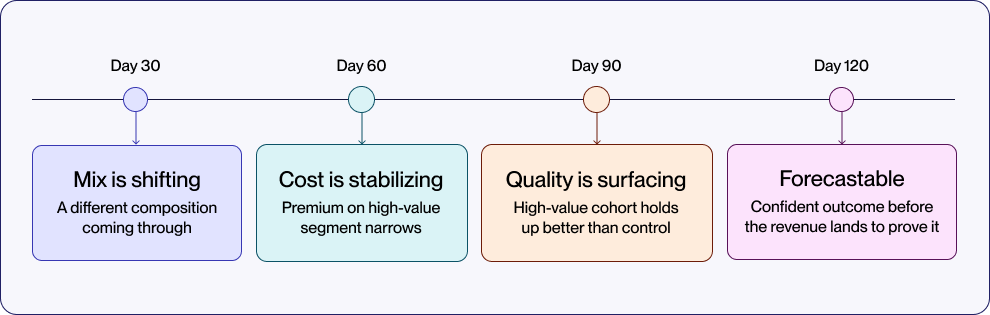
When you cut a campaign at the Day 90 review, you've already paid the full cost of acquiring a better cohort, and you walk away in the exact window before those users start paying you back. The spend is sunk either way. The only question is whether you stay in long enough to collect the return.
How to Set Yourself Up for Success
The same gap that makes results hard to read makes them hard to defend internally. If you set the measurement framework before you launch, the results speak for themselves. If you set it after, you're arguing from behind. Before launch, decide and communicate:
- Which outcome you are testing for
- Which metrics will confirm it
- When you will have enough signal to make a call.
The alternative is canceling a campaign that was working and calling it a failure on the one metric built to miss it.
Both Outcomes Are a Win
Whichever outcome the auction delivers, both move in the same direction. Better users raise the return on what you spend. Better prices lower what you spend for the return and allows you to reinvest the spend, to acquire more users, and generate more revenue. A campaign that dropped CPA and left your user mix alone found the improvement that was actually available. That's the system working exactly as designed.
If you want to work through what this looks like for your campaigns specifically, book time with our team.